
 By Colin Brown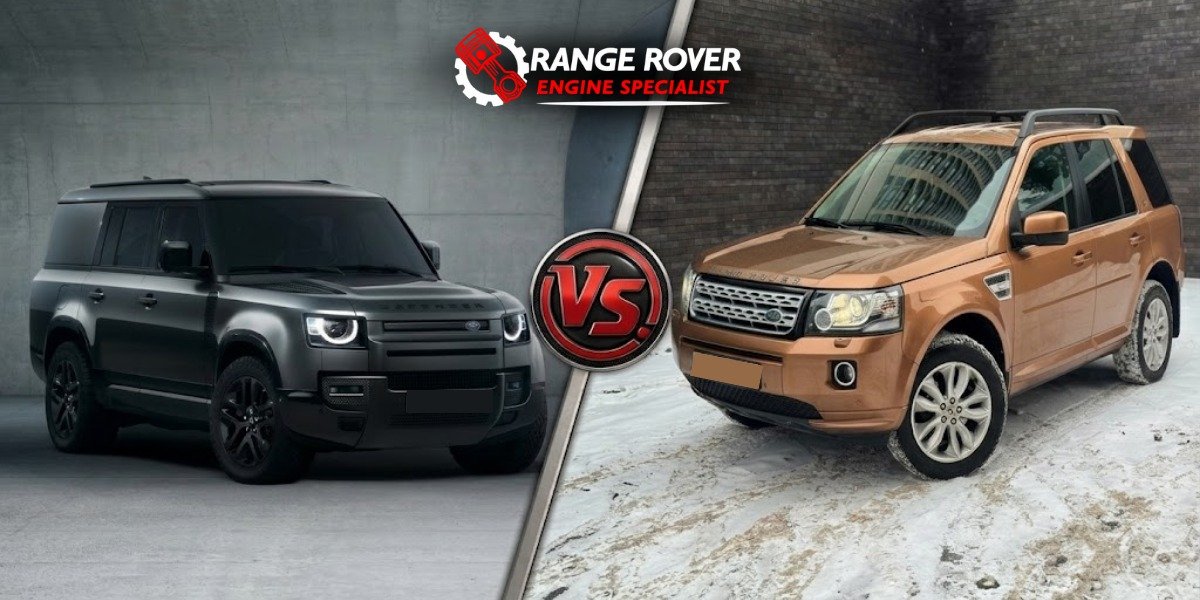
The Land Rover Defender Engine and Land Rover Freelander Engine come from opposite ends of the Land Rover story; one is a modern, six-cylinder mild-hybrid powerhouse, the other a smaller, older four- and six-cylinder unit built for a very different era of SUV ownership. If your Defender or Freelander has thrown a warning light, or you’re simply weighing up power output before buying, this guide breaks down every engine code, the specs behind them, common faults, and what a proper engine replacement should cost. We’re Ranger Rover Engine Specialists, based in Grays, UK, and we supply and fit both models’ engines every week.
Land Rover Defender and Freelander: How They Compare
The new Defender (L663) is built for serious performance, with 3.0-liter straight-six diesel and petrol units, mild-hybrid assistance, and a flagship twin-turbo V8. The Freelander, whether the original L314 (1997–2006) or the Freelander 2 (2006–2014), was engineered as a smaller, more affordable family SUV with four-cylinder and V6 petrol or diesel engines producing a fraction of the Defender’s output. Where the Defender can push past 600 bhp in Octa trim, the Freelander tops out at roughly 240 bhp. Both share the Land Rover badge, but performance, running costs, and parts availability differ hugely between them.
Land Rover Defender Engine Options Explained
The modern Land Rover Defender engine range centers on a 3.0-liter straight-six platform: D200, D250, and D300 diesel units (197–296 bhp) plus the newer D350 (345 bhp), all with mild-hybrid support. Petrol buyers get the P300 (2.0-liter four-cylinder), the P400 straight-six, and the P400e plug-in hybrid combining a 2.0-liter turbo with an electric motor. From 2024, the P425 5.0-litre V8 replaced the P300/P400 petrol line, alongside a standalone 518 bhp V8 and the 616 bhp twin-turbo Octa performance flagship. Earlier classic Defenders (pre-2016) instead ran the Td5, 300Tdi, 200Tdi or 2.2/2.4 TDCi Puma diesel codes, which are still common in reconditioned engine enquiries today.
Land Rover Freelander Engine Options Explained
The Land Rover Freelander engine lineup is simpler. The Freelander 1 (L314) offered the 1.8-litre K-Series petrol, the early 2.0-litre L-series Di/XDi diesel (1998–2001), the BMW-derived 2.0-litre Td4 diesel (2001–2006), and the 2.5-litre KV6 petrol V6. The Freelander 2 (L359, 2006–2014) moved to the 204PT 2.0-litre turbo petrol (around 240 hp) and the 224DT 2.2-litre TD4/SD4 diesel (roughly 150–190 hp depending on tune), alongside an early 3.2-litre straight-six petrol option. Always check the engine code stamped on the block before ordering, as Freelander parts are rarely interchangeable across generations.
Engine Specifications at a Glance
Power and displacement vary sharply between the Defender and Freelander ranges, so we’ve summarized the key figures below. Treat outputs as typical ranges and confirm your exact engine code against the VIN plate before ordering a replacement or reconditioned unit.
| Model | Engine Code | Size | Fuel | Power (approx.) | Years |
| Defender | D200 / D250 / D300 | 3.0L I6 | Diesel (MHEV) | 197–296 bhp | 2020–present |
| Defender | D350 | 3.0L I6 | Diesel (MHEV) | 345 bhp | 2024–present |
| Defender | P300 | 2.0L | Petrol | ~300 bhp | 2020–2023 |
| Defender | P400 | 3.0L I6 | Petrol (MHEV) | ~400 bhp | 2020–2023 |
| Defender | P400e | 2.0L + electric | PHEV | ~296–404 bhp combined | 2021–present |
| Defender | P425 / V8 / Octa | 5.0L V8 / 4.4L V8 | Petrol | 400–616 bhp | 2024–present |
| Freelander 1 | K-Series / Td4 / KV6 | 1.8L–2.5L | Petrol & Diesel | 90–177 bhp | 1997–2006 |
| Freelander 2 | 204PT | 2.0L | Petrol | ~240 hp | 2006–2014 |
| Freelander 2 | 224DT / TD4 / SD4 | 2.2L | Diesel | 150–190 hp | 2006–2014 |
Common Engine Problems on the Defender and Freelander—and How to Fix Them
The 2.0-litre Ingenium units fitted to early Defenders are prone to timing chain rattle on cold start, often caused by oil dilution from incomplete DPF regenerations; left alone, this can progress to crankshaft or bearing failure requiring a full long engine replacement. The straight-six Defender engines are generally more robust but still suffer occasional turbo and injector faults on high-mileage examples. The Freelander 2’s 2.2 TD4/SD4 is well known for head gasket failure and a timing belt that gives no warning before it snaps; proactive replacement at 72,000 miles is essential. Freelander 1 K-Series petrols are also prone to head gasket issues from cooling system weaknesses. Early intervention with a chain, belt, or gasket kit can save the block; once damage spreads, an engine rebuild or replacement unit is the more reliable fix.
Reconditioned Engines vs Used Engines: Which Should You Buy?
Choosing between reconditioned engines vs used engines matters just as much for a Freelander as it does for a modern Defender. A reconditioned engine is stripped down, rebuilt with new timing components, seals, bearings, and gaskets, then tested and sold with a warranty, ideal if you’re keeping the vehicle long-term. A used engine is pulled from a donor vehicle and sold on tested compression alone; it’s cheaper to buy but comes with unknown history and typically shorter cover. For an ageing Freelander where the budget is tight, a checked used unit can make sense; for a Defender you depend on daily, we’d always recommend reconditioned engines for the added peace of mind.
Engine Replacement Costs in the UK
Engine replacement costs in the UK generally sit between £3,260 and £6,490 for parts and labor combined, with diesel units averaging around £5,250 due to turbo and emissions hardware and petrol units closer to £4,850. A brand-new Defender engine from a main dealer can run well past £6,000–£9,000 before fitting, while Freelander parts availability has narrowed as the model ages, pushing genuine new-unit prices up too. Buying a reconditioned engine instead typically saves 40–60% against a dealer replacement, without giving up warranty cover, making it the most cost-effective route for most Defender and Freelander owners facing timing chain, head gasket, or turbo failure.
Ranger Rover Engine Specialist: Supply and Fit Services, Nationwide Logistics & No Deposit Required
Based in Grays, UK, Ranger Rover Engine Specialist stocks Land Rover engines for sale across the Defender and Freelander ranges, along with a dedicated engine rebuild service for owners who’d rather restore their original unit than replace it outright. Our supply and fit services cover the whole of the UK. Our logistics network handles tracked collection and delivery, whether your engine is being fitted at a trusted local garage or shipped straight to your own driveway. We operate with no upfront charges and no deposit require, so nothing is take until your engine code and vehicle details are confirme. Shop our current stock online or call our team to buy the correct engine first time, backed by a warranty and straightforward aftercare.
Frequently Asked Questions
What’s the difference between the Land Rover Defender engine and the Freelander engine?
The Defender runs a modern 3.0-liter straight-six diesel or petrol platform with up to 616 bhp. The Freelander uses older, smaller four-cylinder and V6 units producing under 240 bhp.
How much does a Defender or Freelander engine replacement cost in the UK?
Costs typically range from £3,260 to £6,490 depending on engine size and fuel type. A reconditioned engine costs significantly less than a brand-new dealer unit.
Should I buy a reconditioned or used engine for my Freelander?
A reconditioned engine is rebuild with new wear parts and comes with a warranty. A used engine is cheaper but carries unknown history and shorter cover.
Does Ranger Rover Engine Specialist deliver nationwide?
Yes. We run a UK-wide supply and fit logistics network from our Grays base, with tracked collection and delivery on every order.
Do I need to pay a deposit before ordering an engine?
No. We operate with no upfront charges and no deposit require, so payment is only take once your order and engine code are confirm.
