
 By Colin Brown
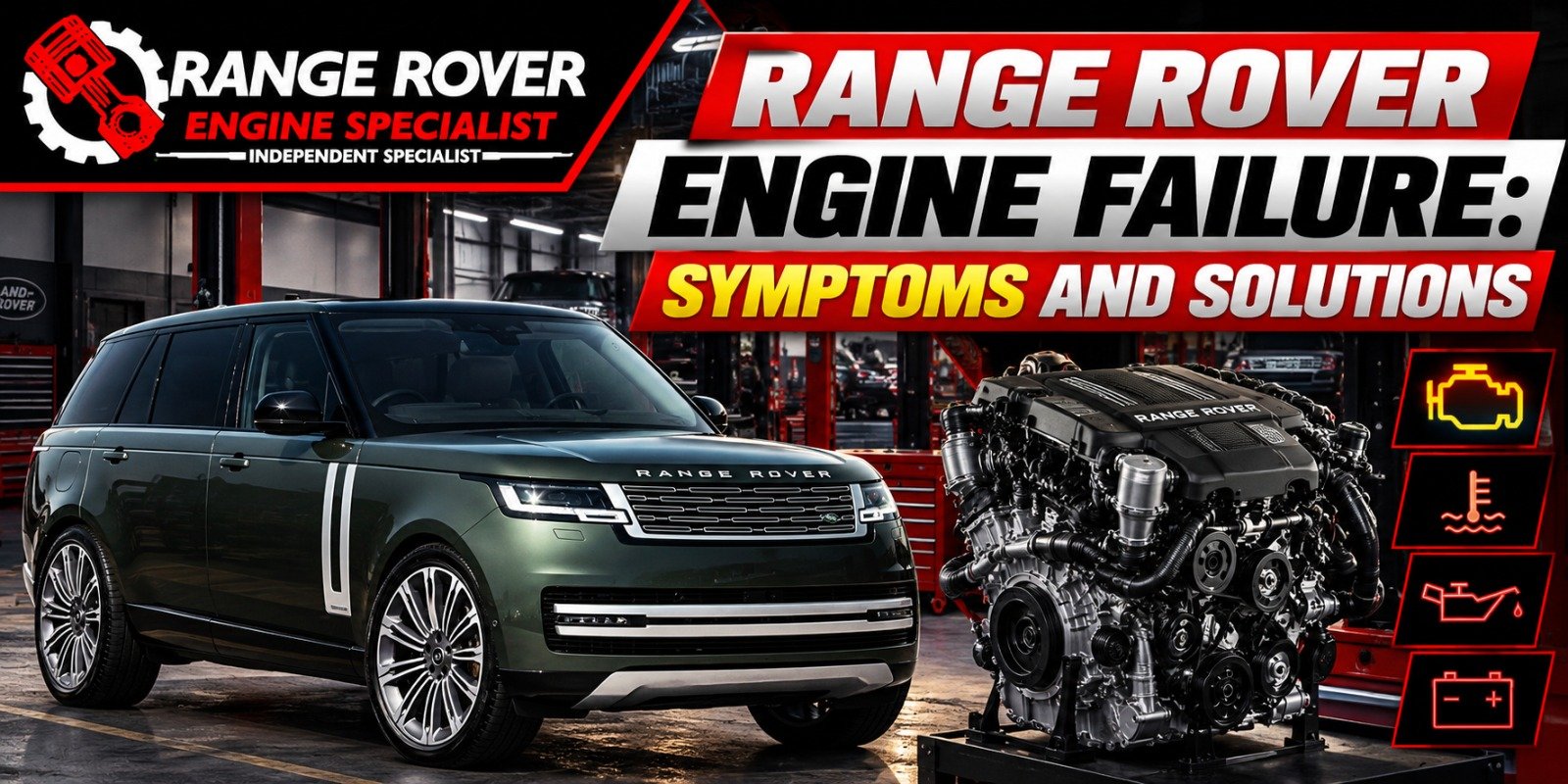
Range Rover engine failure is one of the most stressful and expensive problems an owner can face. However, most engines give clear warning signs before they fail completely. If you spot these signs early, you can often avoid a full engine replacement. At Range Rover Engine Specialist in Grays, UK, we diagnose, rebuild and replace Range Rover engines every day. In this guide, we explain the common symptoms, causes, engine codes, repair options and engine replacement costs in the UK.
Common Range Rover Engine Failure Symptoms
Knowing the early symptoms of Range Rover engine failure can save you thousands of pounds. Here are the most common warning signs we see at our Range Rover garage in Grays:
- Knocking from the engine: This often points to worn crankshaft or rod bearings, especially on the 3.0 diesel.
- Rattle on cold start: This usually means a stretched timing chain or worn tensioners.
- Engine warning light or limp mode: The engine reduces power to protect itself from serious damage.
- Loss of power: This can be caused by turbo faults, injector problems or low compression.
- Smoke from the exhaust: Blue smoke means burning oil, white smoke can mean coolant, and black smoke points to fuel or turbo issues.
- Rising oil level: On diesels, this is a sign of oil dilution caused by DPF regeneration.
- Overheating or coolant loss: Leaks or a failed water pump can quickly damage the engine.
If you notice any of these symptoms, stop driving as soon as it’s safe. Driving on can turn a small repair into a complete engine replacement.
What Causes Range Rover Engine Failure?
Each Range Rover engine has its own known weak points. Understanding them helps you prevent major damage.
3.0 TDV6 / SDV6 diesel (306DT): The best-known fault is crankshaft and bearing failure. It’s often caused by oil starvation or long service intervals. As a result, the crankshaft can snap or seize.
2.7 TDV6 diesel (276DT): Like the 3.0, this engine can suffer crankshaft failure. Timing belt and fuel pump issues are also common on high-mileage units.
4.4 SDV8 diesel (448DT): Turbo failures, oil leaks and timing chain wear are common on this engine.
2.0 Ingenium diesel (204DTA): Timing chain stretch and oil dilution are the main problems.
5.0 V8 Supercharged (508PS): Timing chain guides, tensioners and the water pump often wear out. In addition, the supercharger coupler can rattle.
Other common causes include overheating, poor-quality oil and missed services. Fuel contamination and ignoring warning lights also lead to failure. In short, most failures can be prevented with regular maintenance from a specialist.
Range Rover Engine Codes and Model Table
Before you buy any Range Rover engine for sale, you must know your engine code. The table below shows the most common Range Rover engines in the UK.
| Engine | Models | Years | Engine Code | Size | Power | Torque |
| TDV6 | Range Rover Sport L320 | 2005–2009 | 276DT | 2.7 L V6 diesel | 190 PS | 440 Nm |
| TDV8 | Range Rover L322 / Sport | 2006–2010 | 368DT | 3.6 L V8 diesel | 272 PS | 640 Nm |
| TDV6 / SDV6 | Range Rover / Sport / Vogue | 2009–2018 | 306DT | 3.0 L V6 diesel | 211–306 PS | 520–700 Nm |
| TDV8 / SDV8 | Range Rover / Sport | 2010–2021 | 448DT | 4.4 L V8 diesel | 313–339 PS | 700–740 Nm |
| SD4 / D240 | Sport / Velar | 2016–2020 | 204DTA | 2.0 L I4 diesel | 240 PS | 500 Nm |
| D300 / D350 MHEV | Range Rover / Sport | 2020–present | DT306 | 3.0 L I6 diesel | 300–350 PS | 650–700 Nm |
| P400 MHEV | Range Rover / Sport / Velar | 2019–present | PT306 | 3.0 L I6 petrol | 400 PS | 550 Nm |
| 5.0 V8 Supercharged | Range Rover / Sport | 2009–2022 | 508PS (AJ133) | 5.0 L V8 petrol | 510–575 PS | 625–700 Nm |
| P530 V8 | Range Rover L460 / Sport L461 | 2022–present | BMW-sourced (N63/S68) | 4.4 L V8 petrol | 530 PS | 750 Nm |
Engines with the same code can still have different sumps, wiring and ancillaries. For that reason, we always check your VIN before supplying a replacement.
Range Rover Engine Specifications
Knowing your engine’s specification helps you choose the correct replacement and understand its weak points. Here are the key specs for three popular engines.
3.0 TDV6 / SDV6 (306DT)
- Layout: 60° V6, 24 valves
- Displacement: 2,993 cc
- Bore x stroke: 84.0 mm x 90.0 mm
- Compression ratio: 16.1:1
- Induction: Single turbo (TDV6) or twin turbo (SDV6)
- Block: Compacted graphite iron
2.7 TDV6 (276DT)
- Layout: 60° V6, 24 valves
- Displacement: 2,720 cc
- Bore x stroke: 81.0 mm x 88.0 mm
- Compression ratio: 17.3:1
- Induction: Single variable-geometry turbo
5.0 V8 Supercharged (508PS / AJ133)
- Layout: 90° V8, 32 valves
- Displacement: 4,999 cc
- Bore x stroke: 92.5 mm x 93.0 mm
- Compression ratio: 9.5:1
- Induction: Twin-vortex Roots-type supercharger
These engines deliver strong torque for towing and off-road driving. However, they also put high stress on bearings, chains and turbos. That’s why correct oil, regular servicing and early repairs are so important.
Solutions: Repair, Engine Rebuild or Engine Replacement?
The right solution depends on how serious the damage is. If a fault is caught early, a targeted repair may be enough. For example, you might only need a timing chain kit, a turbo or a water pump. However, if the crankshaft, bearings or pistons are damaged, you’ll need an engine rebuild or a full engine replacement.
Here’s a guide to engine replacement costs in the UK for Range Rover engines:
- Timing chain or turbo repair: around £1,200 to £3,000
- Engine rebuild of your own unit: around £3,500 to £7,000
- Reconditioned 2.7 / 3.0 TDV6, supplied and fitted: around £4,000 to £6,500
- Reconditioned 4.4 SDV8, supplied and fitted: around £6,500 to £10,000
- Reconditioned 5.0 V8 Supercharged, supplied and fitted: around £6,000 to £9,500
By comparison, a new engine from a main dealer can cost £15,000 or more. These prices are only a guide, so always ask for a fixed, itemised quote. Our team will inspect your engine and recommend the most cost-effective solution.
Reconditioned Engines vs Used Engines
When comparing reconditioned engines vs used engines, the main difference is reliability. A used engine comes straight from a donor vehicle. Its mileage and service history are often unknown. As a result, it may already have the same fault that caused your engine to fail, such as a worn crankshaft.
Reconditioned engines, on the other hand, are fully stripped, cleaned and inspected. We replace worn parts such as bearings, piston rings, timing chains, tensioners, seals and gaskets. Next, we check and machine the crankshaft and cylinder heads where needed. Finally, every engine is rebuilt to factory tolerances and tested before it leaves our workshop.
For Range Rover engines, this process is especially important. Known weak points, such as the TDV6 crank issue, are fixed properly during the rebuild.
Although a used engine may cost less at first, it rarely comes with a meaningful warranty. A reconditioned engine, by contrast, gives you near-new reliability and a warranty for peace of mind. That’s why most of our customers choose to shop for reconditioned engines.
Supply and Fit Services With No Upfront Charges
At Range Rover Engine Specialist, our supply and fit services make engine replacement simple. Our team works as a dedicated Range Rover Engine Works, focusing only on Land Rover and Range Rover vehicles.
First, we diagnose the fault using JLR-level equipment. Next, we source the correct engine to match your VIN. Then we fit it in our Grays workshop with fresh oil, filters, coolant and new gaskets. After that, we code the engine, update the software and road-test the vehicle before handover.
Most importantly, we offer No Upfront Charges and No Deposit Required. You only pay once the job is complete and you’re fully satisfied. This removes the financial risk from a major repair.
Every engine also comes with a warranty for added peace of mind. Whether you drive a Range Rover, a Range Rover Sport, a Vogue or a Velar, we can help. If you’re ready to buy a reconditioned Range Rover engine with expert fitting, contact our Range Rover garage in Grays today for a free, no-obligation quote.
UK-Wide Logistics and Delivery From Grays
Range Rover Engine Specialist is based in Grays, Essex, but we serve customers throughout the UK. Our logistics service makes engine replacement easy, no matter where you are.
If your Range Rover has broken down, we can arrange vehicle recovery to our workshop from England, Scotland and Wales. Once the work is complete, we can return your vehicle to your home or business. Alternatively, if you prefer your local garage, we can deliver the engine directly to them.
Every engine is secured to a pallet, sealed against dirt and moisture, and shipped with a trusted courier. In addition, you get tracking updates from dispatch to delivery, so you always know when it will arrive.
Our Grays location is close to the M25, A13 and Port of Tilbury. As a result, we can deliver quickly to London, Essex, Kent and the rest of the country. Next-day delivery is also available on most stock engines. Simply put, you can shop with us online or by phone, and we’ll take care of the rest.
Frequently Asked Questions
1. What are the first signs of Range Rover engine failure?
Common early signs include knocking noises, a rattle on cold start, warning lights and loss of power. Smoke from the exhaust and a rising oil level are also warning signs.
2. Can I keep driving with a knocking Range Rover engine?
No. A knocking noise often means bearing damage, and driving on can destroy the engine. Stop driving and arrange an inspection as soon as possible.
3. How much does a Range Rover engine replacement cost in the UK?
A reconditioned JLR engine supplied and fitted usually costs between £4,000 and £10,000, depending on the engine. We always give a fixed quote before starting work.
4. Do I need to pay a deposit?
No. We offer No Upfront Charges and No Deposit Required, and you only pay once the job is complete.
5. Can you collect my broken-down Range Rover?
Yes. We offer UK-wide vehicle recovery to our Grays workshop and can return the vehicle once the repair is finished.
