
 By Colin Brown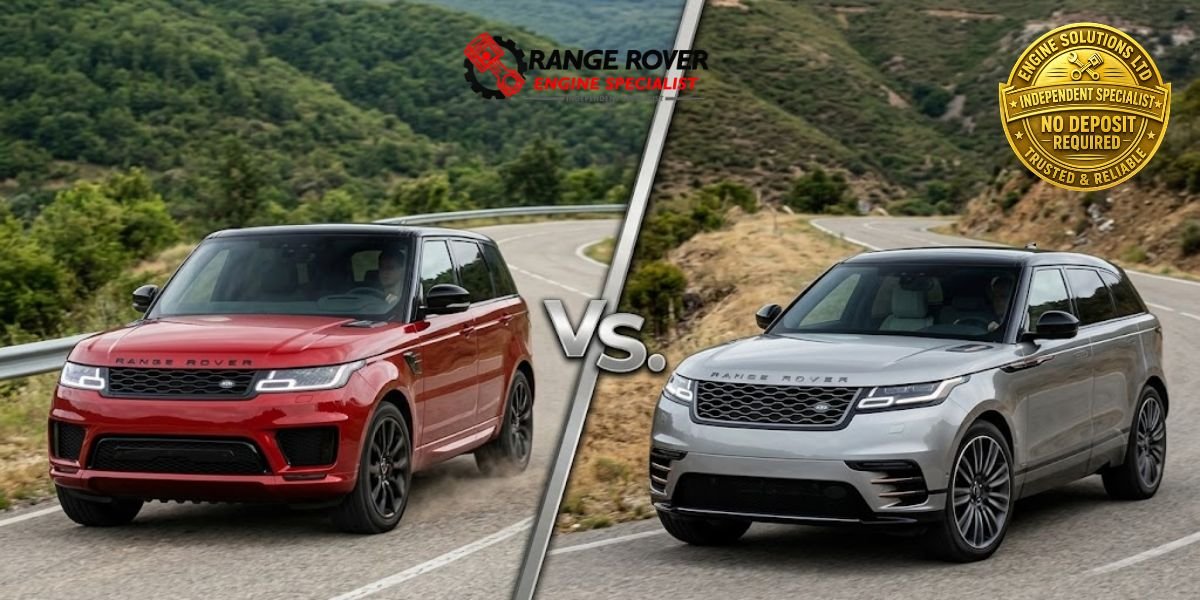
When comparing Range Rover Sport engine vs Range Rover Velar engine reliability, the picture depends heavily on which specific unit you choose rather than the model badge alone. Both vehicles share the same 2.0-litre Ingenium four-cylinder diesel and petrol engines, which have a well-documented history of timing chain and turbocharger issues, particularly in early production years. The Sport’s larger six-cylinder and supercharged V8 options generally prove more durable when serviced correctly, while the Velar’s top-spec six-cylinder units follow a similar pattern of stronger reliability than its four-cylinder base engines. At Range Rover Engine Specialist in Grays, Essex, we supply reconditioned engines for both models, with no upfront charges and no deposit required.
Range Rover Sport and Velar Engine Lineups: An Overview
The Range Rover Sport offers the broadest engine range of the two, spanning the 2.0-litre Ingenium diesel and petrol, a 3.0-litre six-cylinder diesel and mild-hybrid petrol, the older 4.4-litre SDV8 diesel, and a supercharged 5.0-litre V8 in SVR guise. The Velar shares the same 2.0-litre Ingenium four-cylinder engines and 3.0-litre six-cylinder diesel and supercharged petrol options, but never received the SDV8 and only briefly offered a limited-run supercharged V8 in its SVAutobiography Dynamic Edition. This means Range Rover Sport engine options generally extend further up the performance and reliability scale than the Velar’s range.
Reliability by Engine Type: What the Data Shows
Independent reliability data on the 2.0-litre Ingenium four-cylinder, used across both models between roughly 2017 and 2018, points to timing chain stretch, turbocharger failures, and piston-cooling-jet solenoid issues as recurring problems worth avoiding on early cars. Six-cylinder diesel units, including the earlier TDV6 and SDV6, carry a well-documented crankshaft failure risk from manufacturing defects. In contrast, the supercharged V6 and V8 petrol engines fitted to both the Sport and Velar earn stronger reputations for durability, running cleaner at high mileage when serviced on schedule. This pattern suggests that engine choice matters more than model choice when weighing long-term reliability.
Engine Replacement Costs in the UK: Sport vs Velar
Engine replacement costs in UK garages reflect the wider Sport range. A reconditioned 2.0-litre Ingenium unit for either model typically costs £2,800 to £4,200 supplied and fitted. The 3.0-litre six-cylinder diesel and mild-hybrid petrol generally run £3,500 to £6,000 across both models. The Sport-exclusive 4.4-litre SDV8 sits around £3,800 to £6,500, while SVR models with the supercharged 5.0-litre V8 can exceed £6,000 to £10,000 fully fitted. Given these figures, confirming your exact engine code before requesting a quote is the best way to avoid overpaying for the wrong reconditioned unit.
Reconditioned Engines vs Used Engines: Which Lasts Longer?
Whether you drive a Sport or a Velar, the choice between reconditioned engines and used engines has a direct bearing on reliability. A used engine arrives with an unverified history, meaning a crankshaft weakness or existing timing chain wear could already be present and undetected. A reconditioned engine has been fully stripped, inspected, and rebuilt with new bearings, seals, gaskets, and timing components, then tested before dispatch. When weighing reconditioned engines vs used engines for either model, reconditioned units consistently deliver stronger long-term reliability and a proper warranty, making them the sensible choice given the known weak points across both engine ranges.
Range Rover Sport and Velar Engine Specifications and Codes Explained
Confirming your exact engine code ensures the correct reconditioned or used unit is ordered for your Range Rover. The table below sets out the main engine codes and specifications across both models in detail.
| Model | Engine | Code | Displacement | Power Output |
| Velar | D180/D200 Diesel | 204DTD | 2.0L diesel, turbo I4 | 180–200bhp |
| Velar | D240 Diesel | 204DTA | 2.0L diesel, turbo I4 | 240bhp |
| Velar | P250/P300 Petrol | 204PT | 2.0L petrol, turbo I4 | 250–300bhp |
| Velar | D300 V6 Diesel | 306DT | 3.0L diesel, turbo V6 | 275–300bhp |
| Velar | P380 V6 Supercharged | 306PS (AJ126) | 3.0L petrol, supercharged V6 | 380bhp |
| Sport | D200 Diesel | 204DTD | 2.0L diesel, turbo I4 | 200bhp |
| Sport | D300/D350 V6 Diesel | 306DT | 3.0L diesel, turbo V6 | 300–350bhp |
| Sport | P400 MHEV I6 Petrol | 400PT | 3.0L petrol MHEV, turbo I6 | 400bhp |
| Sport | SDV8 Diesel | 368DT | 4.4L diesel, twin-turbo V8 | 339bhp |
| Sport | SVR V8 Supercharged | 508PS/575PS (AJ133) | 5.0L petrol, supercharged V8 | 525–575bhp |
Always confirm your exact engine code from the block or V5C logbook before ordering, and our team can verify compatibility before dispatch.
Common Engine Problems and Solutions Across Both Models
The shared 2.0-litre Ingenium diesel suffers from timing chain failure caused by oil dilution from incomplete DPF regenerations, shown by rattling on cold start; the fix is replacing the chain, guides, idlers, and tensioners before it snaps. Turbocharger whining and power loss are common on both models, typically resolved with a turbo replacement and full oil flush. Piston cooling oil jet solenoid failure occurs when coolant leaks onto its connector from the thermostat housing. The 3.0-litre six-cylinder diesel can develop throttle body clogging and inlet manifold cracks, while older Sport SDV8 and V6 units carry a known crankshaft failure risk requiring careful pre-purchase inspection.
Our Supply and Fit Services & Nationwide Logistics from Grays, Essex
Range Rover Engine Specialist is based in Grays, Essex, giving us quick access to the M25, A13, and Dartford Crossing for efficient logistics across London, the South East, and the rest of the UK. Our supply and fit services include full removal of your failed Sport or Velar engine, careful installation of your reconditioned replacement, and a thorough road test before handover. We also offer engine-only supply for customers using their own trusted garage. Every reconditioned engine is dispatched on secure, tracked nationwide delivery with realistic lead times confirmed in advance, keeping disruption to a minimum whichever model you drive.
No Upfront Charges, No Deposit Required
We understand that a failed Range Rover engine is stressful enough without a large payment demanded before any work has been agreed. That’s why Range Rover Engine Specialist operates with no upfront charges and no deposit required on our reconditioned engine orders, whether you drive a Sport or a Velar. You receive a clear, fixed quote based on your exact engine code before anything is booked in, with payment due only once you’re satisfied. Ready to buy a Range Rover engine built for reliability? Shop our current range of reconditioned engines online, or call our Grays-based team for a personalised supply and fit quote today.
Frequently Asked Questions
How does engine reliability compare between the Range Rover Sport and Velar?
Both share the same 2.0-litre Ingenium four-cylinder weak points, but the Sport’s V8 options generally prove more durable than the Velar’s smaller range.
How much does a Range Rover Sport or Velar engine replacement cost in the UK?
Costs range from £2,800 for a 2.0-litre Ingenium unit up to £10,000+ for an SVR V8, fully supplied and fitted.
Is a reconditioned engine better than a used engine?
Generally yes. A reconditioned engine is rebuilt with new components and tested before dispatch, while a used engine’s true condition remains unknown.
Do I need a deposit to order an engine?
No. Range Rover Engine Specialist offers no upfront charges and no deposit required on reconditioned engine orders, with payment due only once agreed.
Which engine code does my Range Rover have?
Check the engine block stamping or your V5C logbook, or send us your registration number and our team will confirm the correct code for you.
