
 By Colin Brown
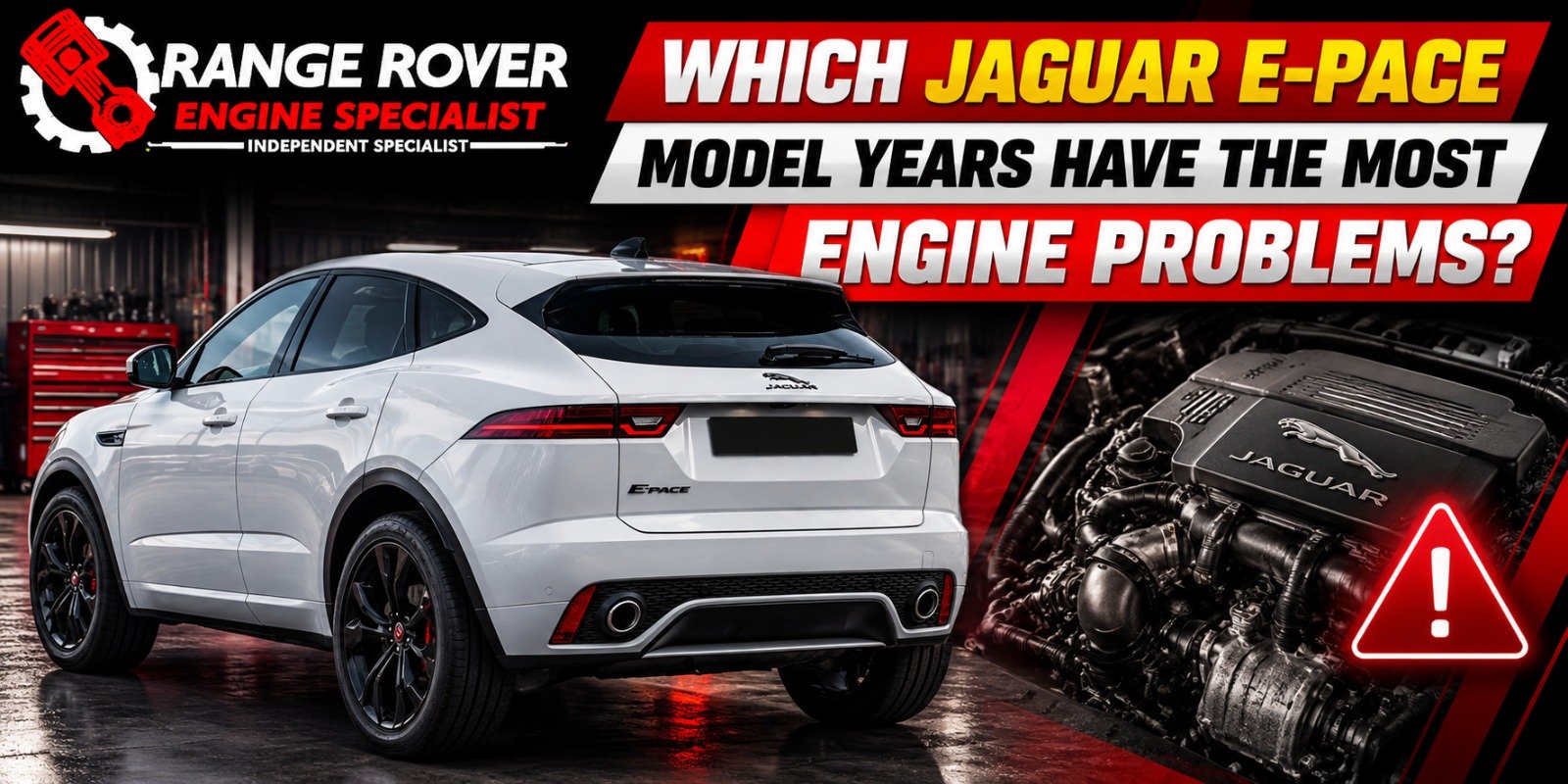
The Jaguar E-Pace is a stylish compact SUV with sharp handling and a premium feel. However, like many modern cars, some model years have more engine problems than others. If you own one, or you’re planning to buy one, it helps to know which years to watch. At Range Rover Engine Specialist in Grays, UK, we repair and replace Jaguar E-Pace engines regularly. In this guide, we cover the problem years, engine codes, specifications, common faults and engine replacement costs in the UK.
Which E-Pace Model Years Have the Most Engine Problems?
Based on common workshop reports, the 2018 and 2019 model years have the most Jaguar E-Pace engine problems. These were the first years of production, and they mainly used early versions of the 2.0 Ingenium diesel and petrol engines. Common issues in these years include timing chain stretch, oil dilution, EGR cooler faults and coolant leaks.
The 2020 model year was a little better. By then, Jaguar had made several software updates and part improvements. However, many 2020 cars still used the same basic engine design.
From 2021, the facelifted E-Pace introduced mild hybrid (MHEV) diesel and petrol engines, plus a plug-in hybrid P300e. These newer models have fewer chain problems. Instead, some owners report issues with the 48V mild hybrid system, sensors and software. In addition, the P300e has had high-voltage battery recalls.
Even so, a well-maintained early E-Pace can still be reliable. Service history matters more than the year alone. Before you buy, always check the car’s recall history on the official GOV.UK vehicle recall checker.
Jaguar E-Pace Engine Codes and Model Table
The E-Pace was sold from 2018 to 2024 with a range of Ingenium engines. Knowing your engine code is essential before you buy any Jaguar engine for sale.
| Engine | Years | Engine Code | Size | Power | Torque |
| D150 | 2018–2020 | 204DTD | 2.0 L I4 diesel | 150 PS | 380 Nm |
| D180 | 2018–2020 | 204DTD | 2.0 L I4 diesel | 180 PS | 430 Nm |
| D240 | 2018–2020 | 204DTA | 2.0 L I4 twin-turbo diesel | 240 PS | 500 Nm |
| P200 / P250 | 2018–2020 | PT204 | 2.0 L I4 petrol | 200–249 PS | 320–365 Nm |
| P300 | 2018–2020 | PT204 | 2.0 L I4 petrol | 300 PS | 400 Nm |
| D165 MHEV | 2021–2024 | 204DTD (MHEV) | 2.0 L I4 diesel | 163 PS | 380 Nm |
| D200 MHEV | 2021–2024 | 204DTD (MHEV) | 2.0 L I4 diesel | 204 PS | 430 Nm |
| P200 / P250 MHEV | 2021–2024 | PT204 (MHEV) | 2.0 L I4 petrol | 200–249 PS | 320–365 Nm |
| P160 | 2021–2024 | PT153 | 1.5 L I3 petrol | 160 PS | 260 Nm |
| P300e PHEV | 2021–2024 | PT153 + motor | 1.5 L I3 hybrid | 309 PS | 540 Nm |
The 2.0 diesel (204DTD) is the most common E-Pace engine in the UK. It’s also the engine we see most often at our Jaguar engine garage in Grays. To confirm your engine code, simply send us your VIN.
Jaguar E-Pace Engine Specifications
Here are the key specifications for the two most common E-Pace engines.
2.0 Ingenium Diesel (204DTD / 204DTA)
- Layout: Inline four-cylinder, DOHC, 16 valves
- Displacement: 1,999 cc
- Bore x stroke: 83.0 mm x 92.4 mm
- Compression ratio: 15.5:1
- Induction: Single VGT turbo, or sequential twin turbos on the D240
- Fuel system: 2,000-bar common-rail injection
- Camshaft drive: Timing chain at the rear of the engine
- Emissions: DPF and AdBlue (SCR)
2.0 Ingenium Petrol (PT204)
- Layout: Inline four-cylinder, DOHC, 16 valves
- Displacement: 1,997 cc
- Bore x stroke: 83.0 mm x 92.3 mm
- Induction: Twin-scroll turbocharger
- Valve control: Continuously variable valve lift (on the intake side)
- Camshaft drive: Timing chain
Both engines use a light aluminium block and head. They’re efficient and responsive, but they’re also sensitive to oil quality. Because the timing chain sits at the back of the engine, chain repairs usually need the engine or gearbox removed. As a result, they cost more than on many other cars.
Common E-Pace Engine Problems and Warning Signs
Here are the most common Jaguar E-Pace engine problems we see:
- Timing chain stretch: This is mostly found on 2018–2020 diesels. Long oil change intervals and soot in the oil speed up chain wear.
- Oil dilution: Short trips stop the DPF from regenerating fully. Extra fuel then mixes with the oil and thins it.
- EGR cooler faults: Early diesels can suffer from coolant leaks or EGR blockages.
- Coolant leaks: Plastic pipes, the thermostat housing and the water pump can leak with age.
- Turbo problems: Poor oil quality can damage turbo bearings.
- MHEV and hybrid faults: Later models can develop 48V system, sensor or battery problems.
Watch out for these warning signs:
- A rattle on cold start
- An engine warning light or limp mode
- A rising oil level on the dipstick
- Coolant loss or overheating
- White or blue exhaust smoke
- Loss of power
If you notice any of these signs, book an inspection straight away. Catching problems early can prevent a full engine replacement.
Why Choose Our Engines?
When comparing reconditioned engines vs used engines, the risk is clear. A used E-Pace engine comes from a donor car with an unknown history. If it’s a 2018 or 2019 engine, it may already have a stretched timing chain or oil dilution damage. As a result, it could fail soon after fitting.
Our reconditioned JLR engines, on the other hand, are fully stripped, cleaned and inspected. During every rebuild, we fit a new timing chain, guides and tensioners. We also replace bearings, piston rings, seals and gaskets. Next, we check and machine the cylinder head and crankshaft where needed. Finally, every engine is rebuilt to factory tolerances and tested before dispatch.
Here’s why our customers choose us:
- Known Ingenium weak points are fixed during the rebuild.
- Every engine comes with a warranty.
- Engines are matched to your exact VIN and engine code.
- Prices are clear, with no hidden extras.
Although a used engine may look cheaper, a second failure costs far more. That’s why most E-Pace owners choose to shop for reconditioned engines rather than used ones.
UK’s No.1 Engine Reconditioners
At Range Rover Engine Specialist, we focus only on Jaguar and Land Rover engines. As a result, our team has deep experience with every Ingenium engine used in the E-Pace.
Our supply and fit services cover the whole job from start to finish. First, we source or rebuild the correct engine for your vehicle. Next, we fit it with fresh oil, filters, coolant and new gaskets. After that, we code the engine, update the software and road-test your E-Pace before handover.
Most importantly, we offer No Upfront Charges and No Deposit Required. You only pay once the job is complete and you’re fully happy. This removes the financial risk from a major repair.
We also keep a wide range of Jaguar engines for sale in stock, which helps cut waiting times. Whether you drive a D150, D180, D200 or P250, we can help. If you’re ready to buy a reconditioned Jaguar E-Pace engine, contact our team today for a free, no-obligation quote.
Real Engine Work, Real Specialist Support
At our Jaguar engine garage in Grays, every job is handled by specialists. Our Jaguar engine works team uses JLR-level diagnostic equipment to find the real cause of the problem. Then we explain whether you need a repair, an engine rebuild or a full engine replacement.
Here’s a guide to engine replacement costs in the UK for the E-Pace:
- Timing chain replacement (2.0): around £1,500 to £3,000
- EGR cooler replacement: around £800 to £1,500
- Engine rebuild of your own unit: around £3,000 to £5,500
- Reconditioned 2.0 Ingenium, supplied and fitted: around £3,500 to £5,500
These prices are only a guide, and your final price depends on your model and its condition. That’s why we always provide a fixed, itemised quote before starting work.
We also give honest advice. If a simple repair will fix the problem, we’ll tell you. In addition, we share aftercare tips to help your engine last longer. In short, you get real engine work and real specialist support.
Nationwide Vehicle Recovery
Range Rover Engine Specialist is based in Grays, Essex, but we serve Jaguar owners across the whole UK. Our logistics service makes engine replacement easy, wherever you are.
If your E-Pace can’t be driven, we can arrange nationwide vehicle recovery to our workshop from England, Scotland and Wales. Once the work is complete, we can return the vehicle to your home or business. Alternatively, if you prefer to use your local garage, we can deliver the engine directly to them.
Every engine is secured to a pallet, sealed against dirt and moisture, and shipped with a trusted courier. In addition, you get tracking updates from dispatch to delivery, so you always know when it will arrive.
Our Grays location is close to the M25, A13 and Port of Tilbury. As a result, we can deliver quickly to London, Essex, Kent and the rest of the country. Next-day delivery is also available on most stock engines. Simply put, you can shop with us online or by phone, and we’ll handle the rest.
Frequently Asked Questions
1. Which Jaguar E-Pace years have the most engine problems?
The 2018 and 2019 models have the most reported engine issues, especially with the 2.0 diesel. Later models from 2021 have fewer chain problems but can have hybrid system faults.
2. What is the most common E-Pace engine problem?
Timing chain stretch on the 2.0 Ingenium diesel is the most common problem. Oil dilution and coolant leaks are also common.
3. How much does an E-Pace engine replacement cost in the UK?
A reconditioned 2.0 Ingenium engine supplied and fitted usually costs around £3,500 to £5,500. We always give a fixed quote first.
4. Do I need to pay a deposit?
No. We offer No Upfront Charges and No Deposit Required, and you only pay once the job is complete.
5. Can you collect my E-Pace if it won’t start?
Yes. We offer nationwide vehicle recovery to our Grays workshop and can return your car once the job is finished.
